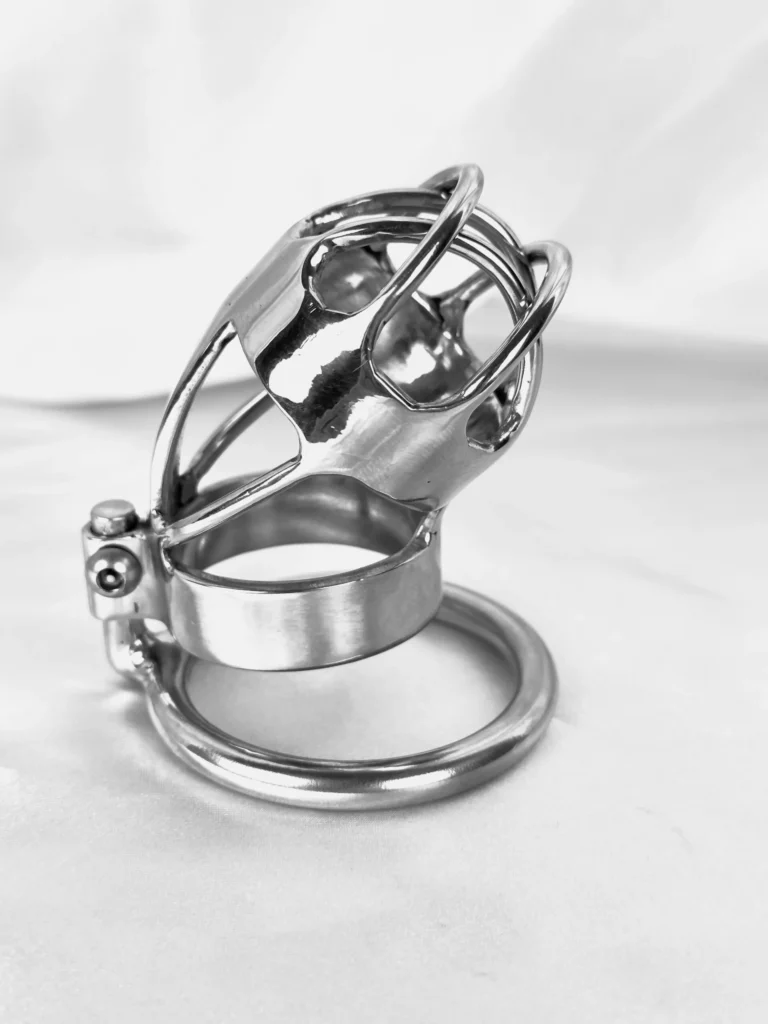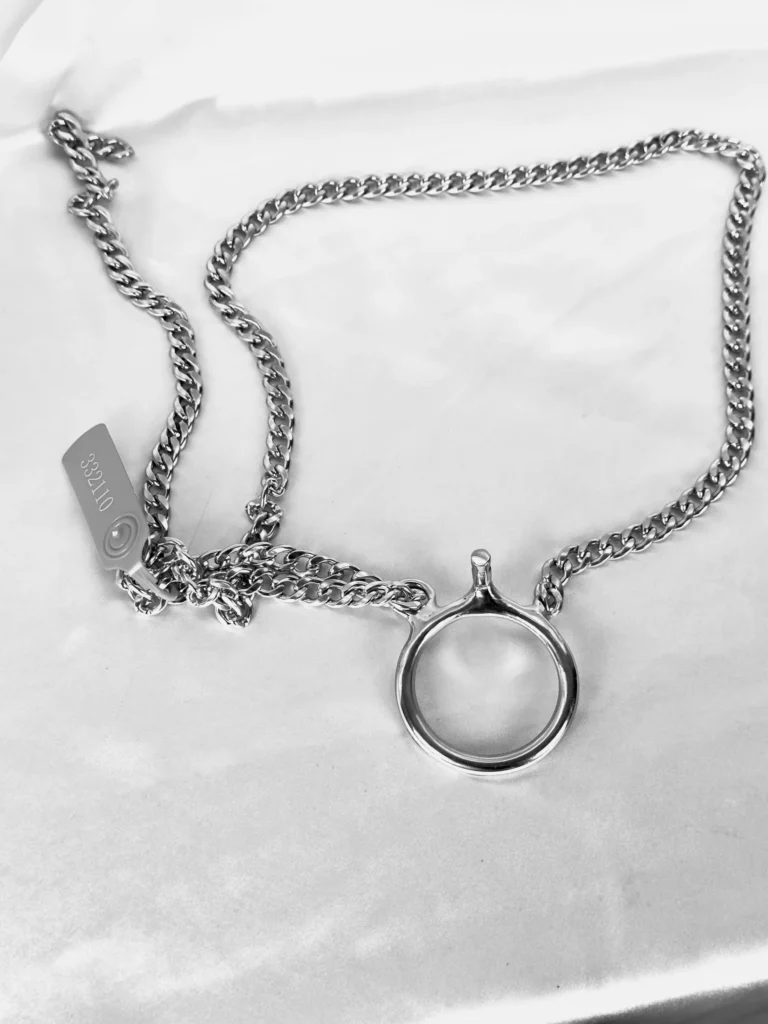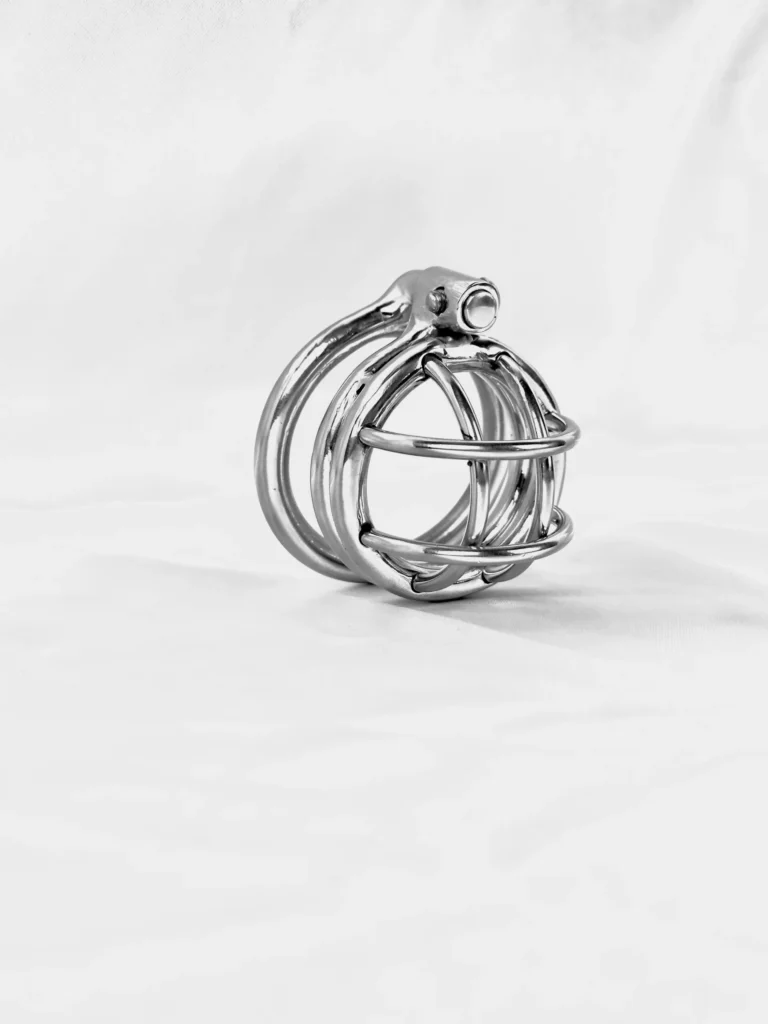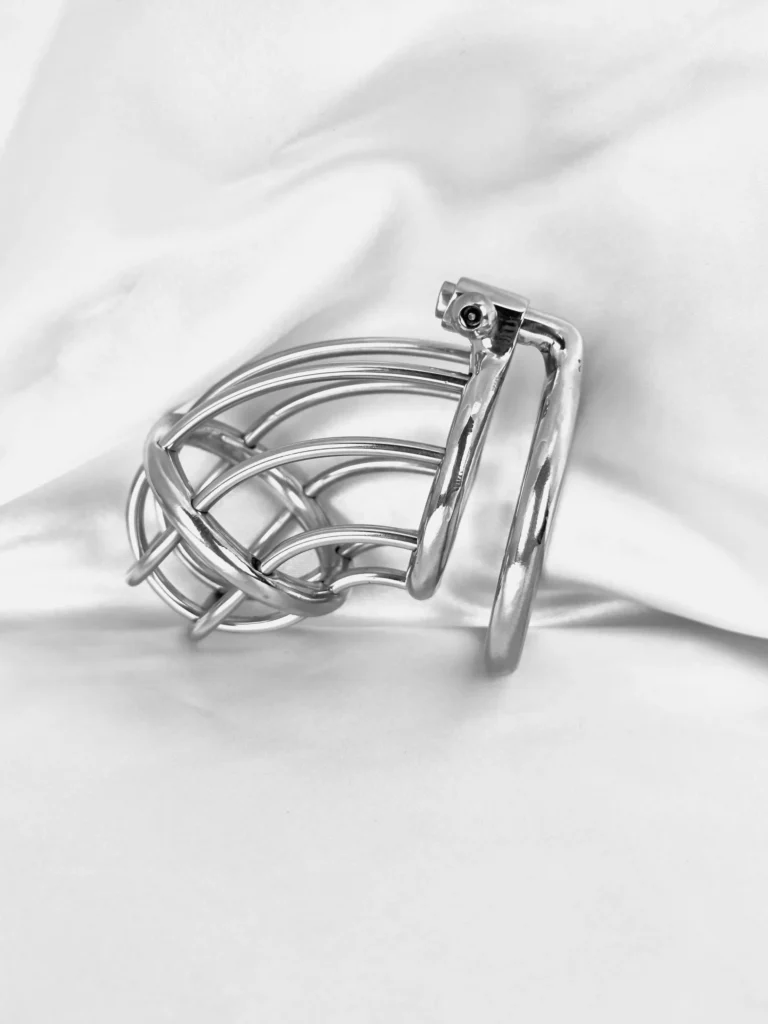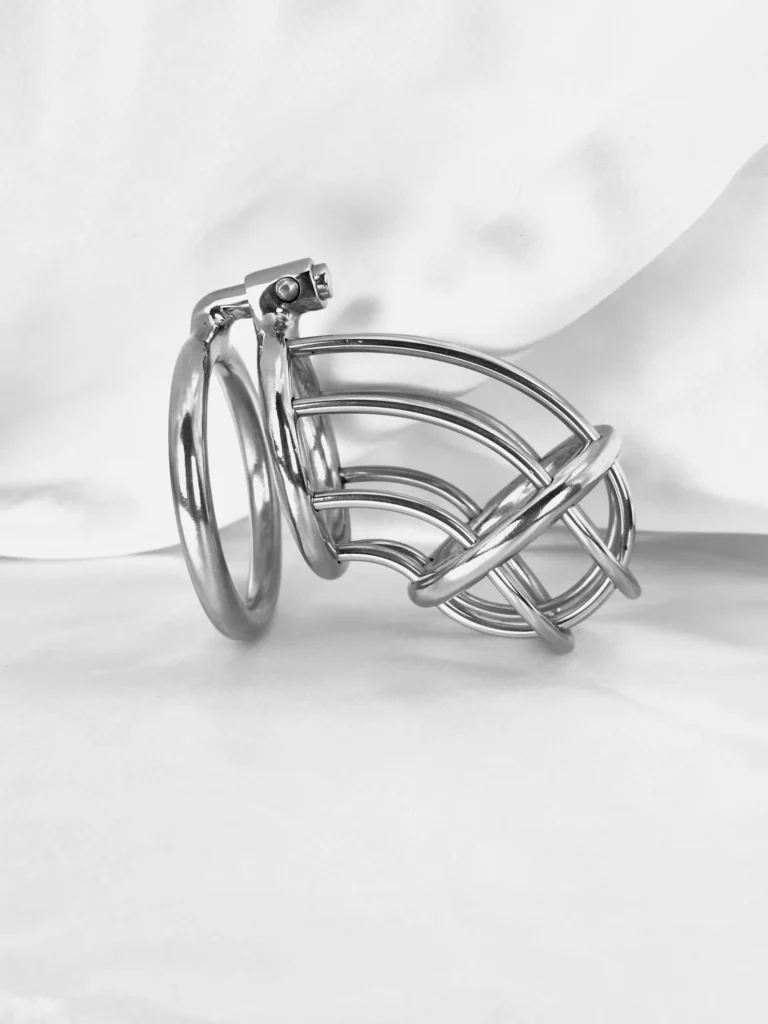
The most common first email we receive asks how our measurements compare to another manufacturer’s cage. Our answer is almost always the same: start fresh. Every maker measures differently, and even a cage you’d call comfortable can get better. The best cage is the one you forget you’re wearing, and when you take it off, you feel like you’re forgetting something.
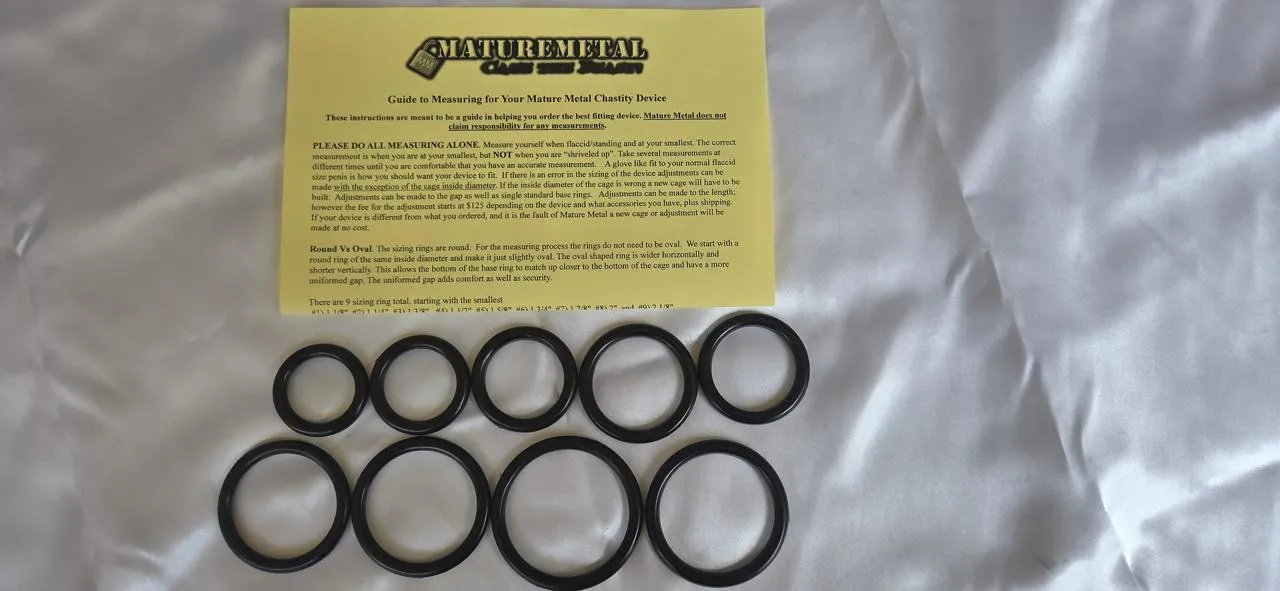
Chastity cage sizing comes down to four sizes: the cage’s inside diameter, the base ring’s inside diameter, the length, and the gap. Two of them are found by wearing our plastic sizing rings. One takes a hard ruler and a simple rule. The last one is a choice, not a measurement. This chastity cage size guide walks through all four the way we’ve walked thousands of clients through them since 2009, with the reasoning included. The short official version lives in our measuring guide; consider this the long companion.
A chastity device sits against some of the least forgiving anatomy you own, for days at a stretch. If it isn’t comfortable, you won’t wear it 24/7, and isn’t that the goal? Off-the-shelf sizing works the way letter sizes work in shirts: small, medium, and large describe thousands of bodies at once, which means they describe yours approximately at best. A cage built to your numbers outperforms one built to somebody’s average every single day it’s worn. Telling your Keyholder the device has to come off because it’s uncomfortable should not be an option.
Now the fact that organizes everything below. Of the four sizes, only one is permanent: the cage’s inside diameter. Get that one wrong and the fix is a new cage. The base ring diameter, the gap, and the length are different: unlike other manufacturers, we can adjust all three on the cage you already own, no new ring required. So the four sizes don’t carry equal weight. One of them deserves the most care, and our whole method is built to give it exactly that.
Nearly every sizing guide on the internet starts with a piece of string or a tailor’s tape. In William’s words: measuring with a string is the worst way to measure. Soft tape wrapped around soft tissue, under whatever tension your hand applied that morning, produces confident numbers that have nothing to do with how a rigid steel ring behaves on a body through a workday and a night of erections. Tape and string have filled a lot of drawers with expensive cages that never fit.
Diameters are found by wearing hard rings, never by wrapping and calculating. That has been the entire philosophy of our fitting process since we built the sizing kit in 2009, and one of the kit’s own reviews tells you why: a couple measured carefully from several online guides, and every number turned out wrong the moment real rings went on the body.
These apply to every test and every reading, and they come straight from the sheet we pack with the kit.
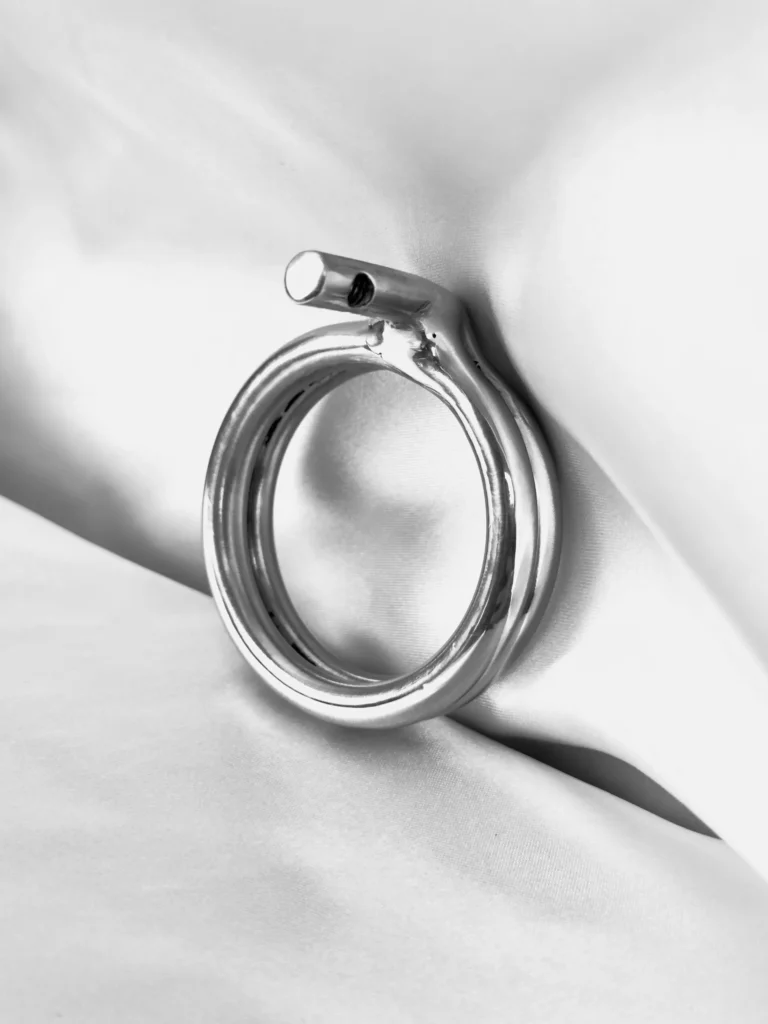
The base ring goes behind the testicles, flat against the body, and it does the carrying. Here is exactly how we tell clients to find it.
Lay the kit’s nine rings out smallest to largest (they’re unnumbered, so the lineup is how you identify each size). Start with the largest ring. One testicle through at a time, then tuck the penis through. A drop of baby oil helps the ring on. Then do something to take your mind off it — watch TV, do something unexciting — and wait until you’re at your normal flaccid state.
Now the test: see how many fingers you can slide under the top of the ring, up to the first knuckle, without forcing. Exactly one finger, feeling slightly snug, means the ring is right. Two fingers means it’s a size too big; move down one and repeat. No fingers means too small; move up. You’re after a ring tight enough to hold up the cage and loose enough to allow blood flow. Continue until you’re confident, then give the winner at least a week of ordinary days and nights before ordering.
Two things worth knowing while you test. If an erection arrives mid-test, the bare ring behaves like a cock ring and will probably hurt. Stay calm and let it pass: in the finished device the cage holds erections back, so a caged erection is pressure, not pain. And if your body changes years from now, this is one of the sizes we can adjust on your existing device.
This is the most important number of the four, because it’s the one that can never be adjusted. If it’s wrong, the fix is a new cage. It gets the same hard-ring treatment, as its own separate test — never with the base ring test running at the same time.
Put the ring you think fits best on the shaft. Distract yourself again (if you know how to knit, that may help). Then just look down. The right size just indents the skin. If you can see space between skin and ring, it’s too big; go a size smaller and repeat until the indent is there and nothing is compressed.
Length is the only ruler measurement in the whole process. Place a hard ruler under the penis, just touching the scrotum — do not push in — and read out to the tip at your normal flaccid state. Do it several times, at different times of day, never straight from a shower. Then take the shortest measurement you collected and subtract 1/4″ (6 mm). That’s your cage length.
Better a little short than a little long: you should fill the cage and touch the tip when you’re at your normal state. And to be precise about what the number means on our order form: cage length is the cage only, measured down its inside center. It doesn’t include the ring or the gap.
The gap is the space your scrotum occupies between the base ring and the back of the cage, and there’s no good way to measure it. So it’s chosen, and the pattern across thousands of orders is steady.
|
Gap |
Who it suits |
|---|---|
| 3/8″ (9.5 mm) |
The default. It fits most of our clients. |
| 1/2″ (12.7 mm) |
A high, tight scrotum, or a history of a burning sensation in the scrotum with previous cages. |
| 1/4″ (6.3 mm) |
A low-hanging scrotum. |
If you’re unsure, 3/8″ is the answer, and here’s why not to lose sleep over it: every cage is handmade, so the gap can be made any size and adjusted afterward. We’ll even show you how to make small gap adjustments yourself, or happily do them for you. One related note from years of fit emails: if a cage tends to slide down on you, the fix is often a double base ring rather than a different gap.
A detail for the curious: manufacturers don’t even measure the gap the same way. Some measure from the bottom of the cage back to the bottom of the base ring, which means the number shifts with every ring size and shape. We measure straight across, from the bottom of the cage to the side of the base ring, so your gap means the same thing whatever ring you order.
Our devices offer the base ring in round or oval, and the sizing rings are round. That’s not a limitation, because an oval ring has the exact same inside diameter as the round: we make the round ring you ordered first, then shape it slightly oval so it’s wider than it is tall. Find your size in round, and the oval option is fully sized. Whether the oval suits your anatomy is a judgment call we’re glad to make with you by email.
Seventeen years of fitting emails, sorted into six piles:
Ordering works the same way for every device we build, from the Jail Bird down:
Between sizes, or outside the kit’s range entirely? We can make any size cage or ring; there may be an upcharge depending on what’s needed, so email first and we’ll sort it out. Two policies make the double-check worth your time: once production starts no changes can be made, and custom devices are final sale, backed by a lifetime warranty against manufacturing defects. Questions at any point go to maturemetalsales@gmail.com or a phone call, and they’re answered personally by Mistress MM or William, the owners. Fitting questions are most of what we do.
When the box arrives, we’ve covered the next step too: how to put on a chastity cage, without the struggle. And for the kit itself, the full companion is here: reading your sizing-ring results.
Weight moves, seasons turn, and a fit that was invisible can start announcing itself: new pinching, new slipping, marks that linger. Don’t negotiate with it. Spend a few days back in the sizing rings — they’re yours to keep for exactly this reason — and email the workshop with your old sizes and your new ones. Because we can adjust the base ring diameter, the gap, and the length on your existing device, a change of body rarely means a change of cage. Only the cage diameter is forever, which is why it got the most careful test back at the start.
Everything above is about fit. This part is about tissue, and it is not negotiable.
Numbness, tingling, coldness to the touch, or any change of color means the device comes off now. Not at the end of a challenge, and not once someone holding a key becomes reachable; a wearer’s request for release is honored immediately, every time. Severe pain, swelling, broken skin, or any difficulty urinating means the device comes off and a doctor takes a look. Urologists are unshockable. Go.
Some adjustment in the first days is normal. Significant pain never is, and it almost always means a sizing problem, which is exactly the kind of email we answer all day. Certain medical conditions can make wearing a device inadvisable, so if you have concerns, talk with a healthcare provider first. This guide is general information from the people who make the devices, not medical advice about your body.
How do you measure for a chastity cage? Four sizes complete an order: cage inside diameter and base ring inside diameter, both found by wearing hard sizing rings; length, taken with a ruler under the penis at your normal flaccid state, shortest reading minus 1/4″; and the gap, which is chosen rather than measured. The kit’s enclosed sheet walks you through each one.
Do you measure soft or hard? At your normal flaccid state, always: alone, unhurried, never straight out of a shower. If an erection interrupts a ring test, stay calm and let it pass before continuing. The finished cage is sized for your flaccid state and holds erections back as pressure, not pain.
Which size matters most? The cage’s inside diameter, because it’s the only one that can never be adjusted; getting it wrong means a new cage. The base ring diameter, the gap, and the length can all be adjusted on your existing device, which is a flexibility most manufacturers can’t offer.
What size gap should I choose? 3/8″ fits most of our clients and is the default. A high, tight scrotum, or a history of burning in the scrotum with other cages, points to 1/2″. A low-hanging scrotum points to 1/4″. Every cage is handmade, so the gap can be made any size and adjusted after delivery.
Can I size my custom cage from the device I already wear? We’d rather you didn’t. Every manufacturer measures differently, so start fresh with the sizing rings: the comparison question is the most common first email we get, and “start fresh” is almost always the answer. Even a cage that feels comfortable can get better, and the rings are how you find out.
More answers live in our FAQs, and the inbox is always open.
Note for build: mark the block above up as FAQPage schema.
Order the plastic sizing rings, work through the enclosed sheet at your own pace, and give the winning sizes a week of ordinary life. Then order your device, or send your results to the workshop first and one of us will look them over with you. Measured once, worn for decades: that’s the whole idea.