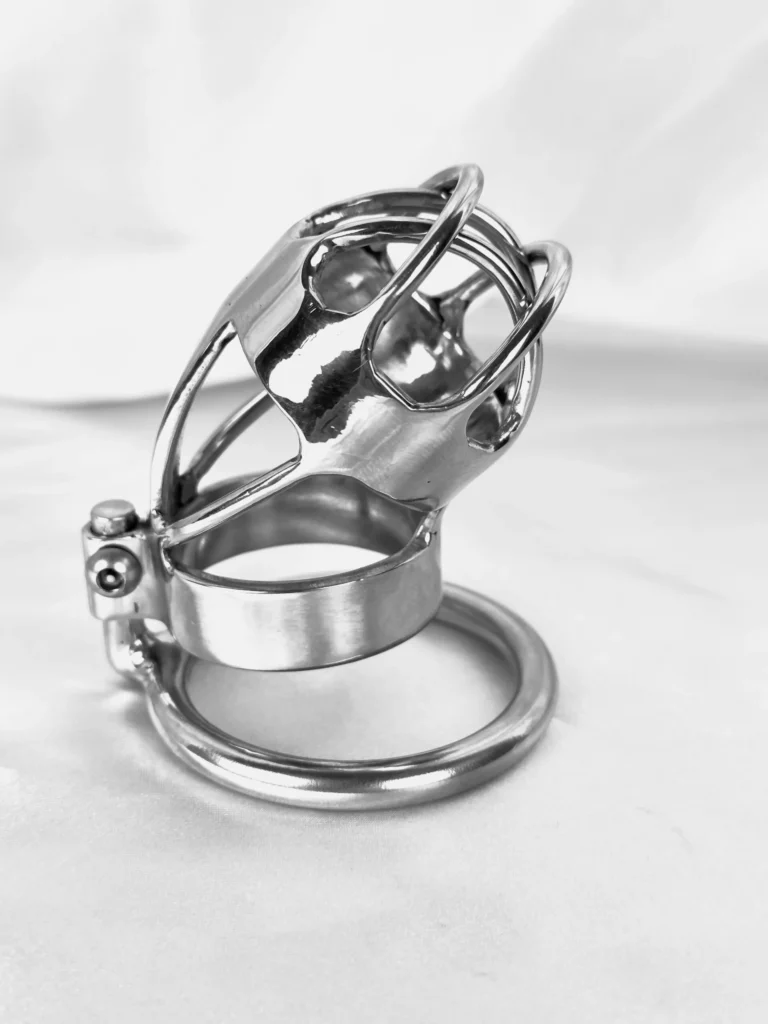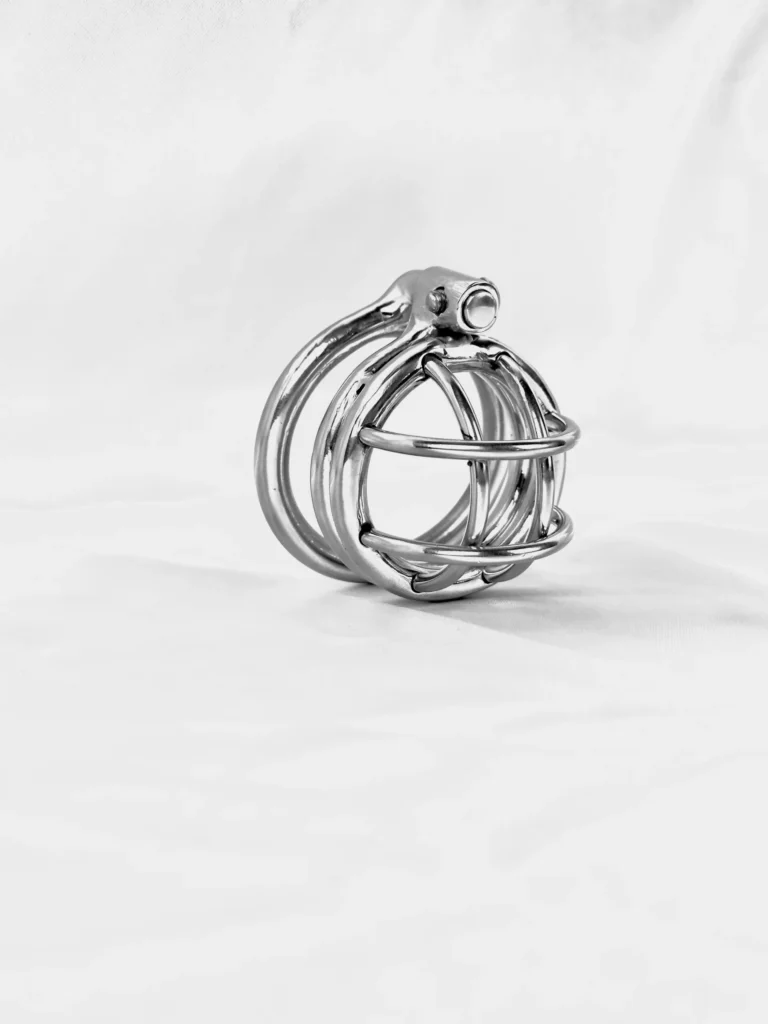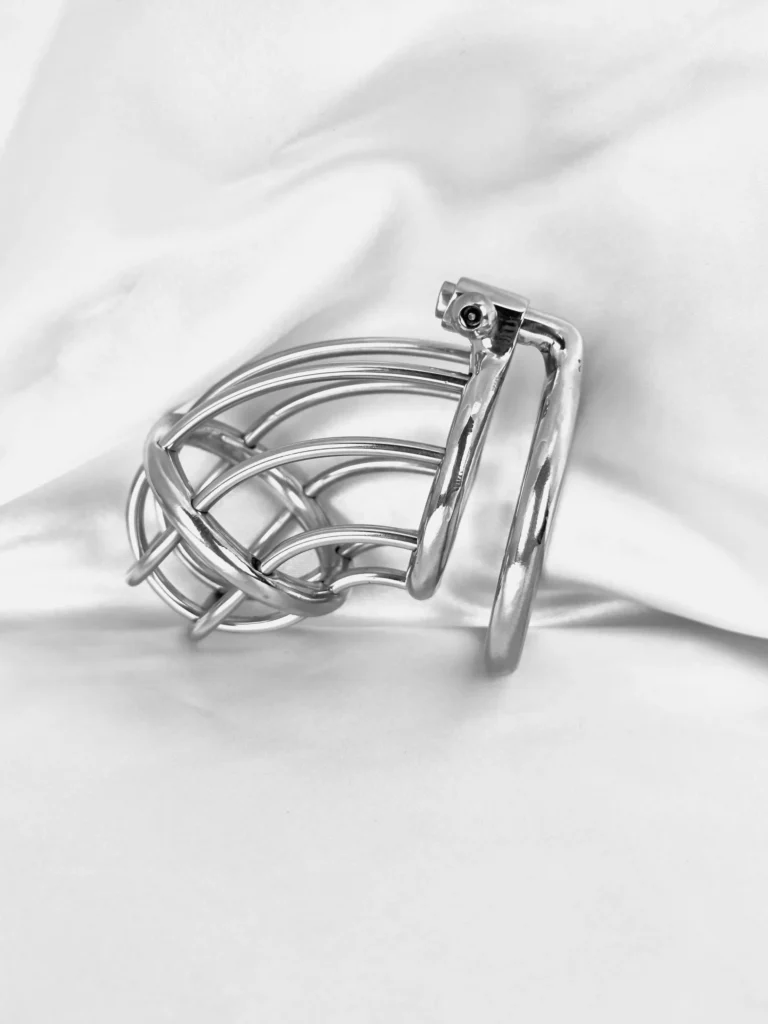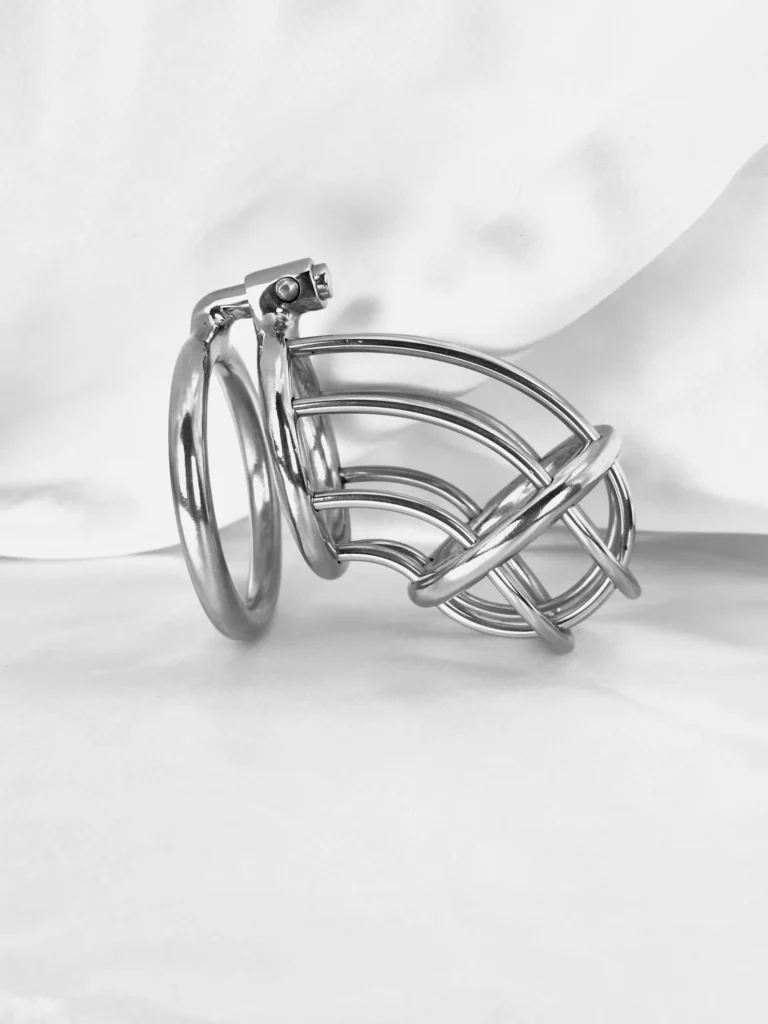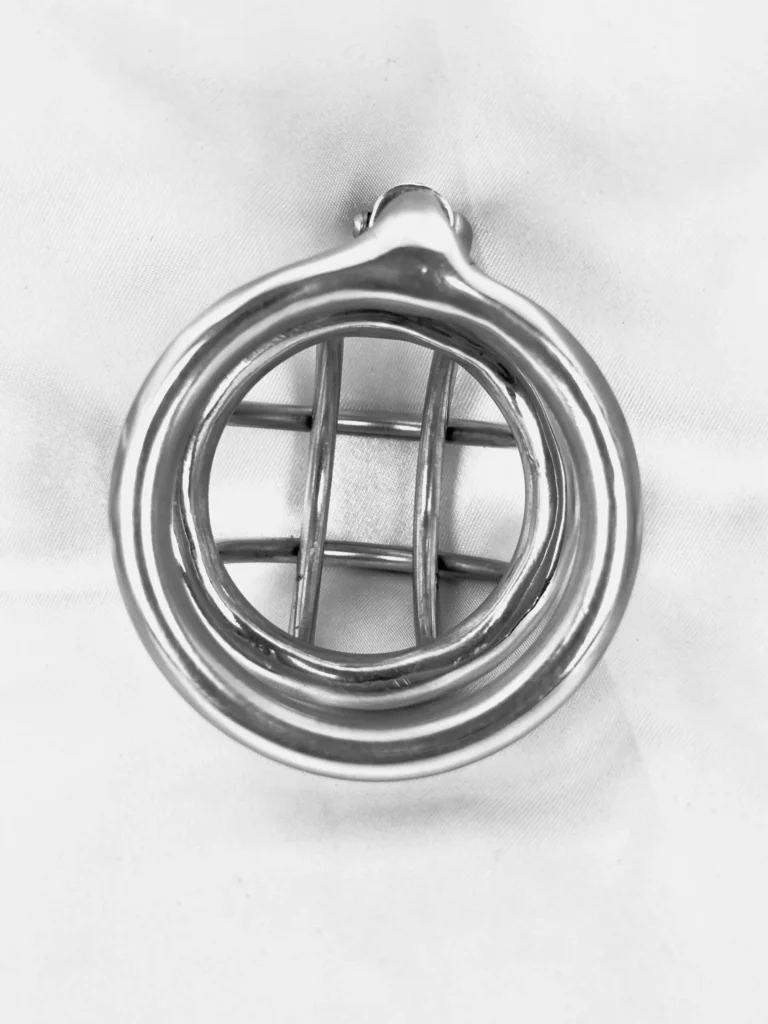
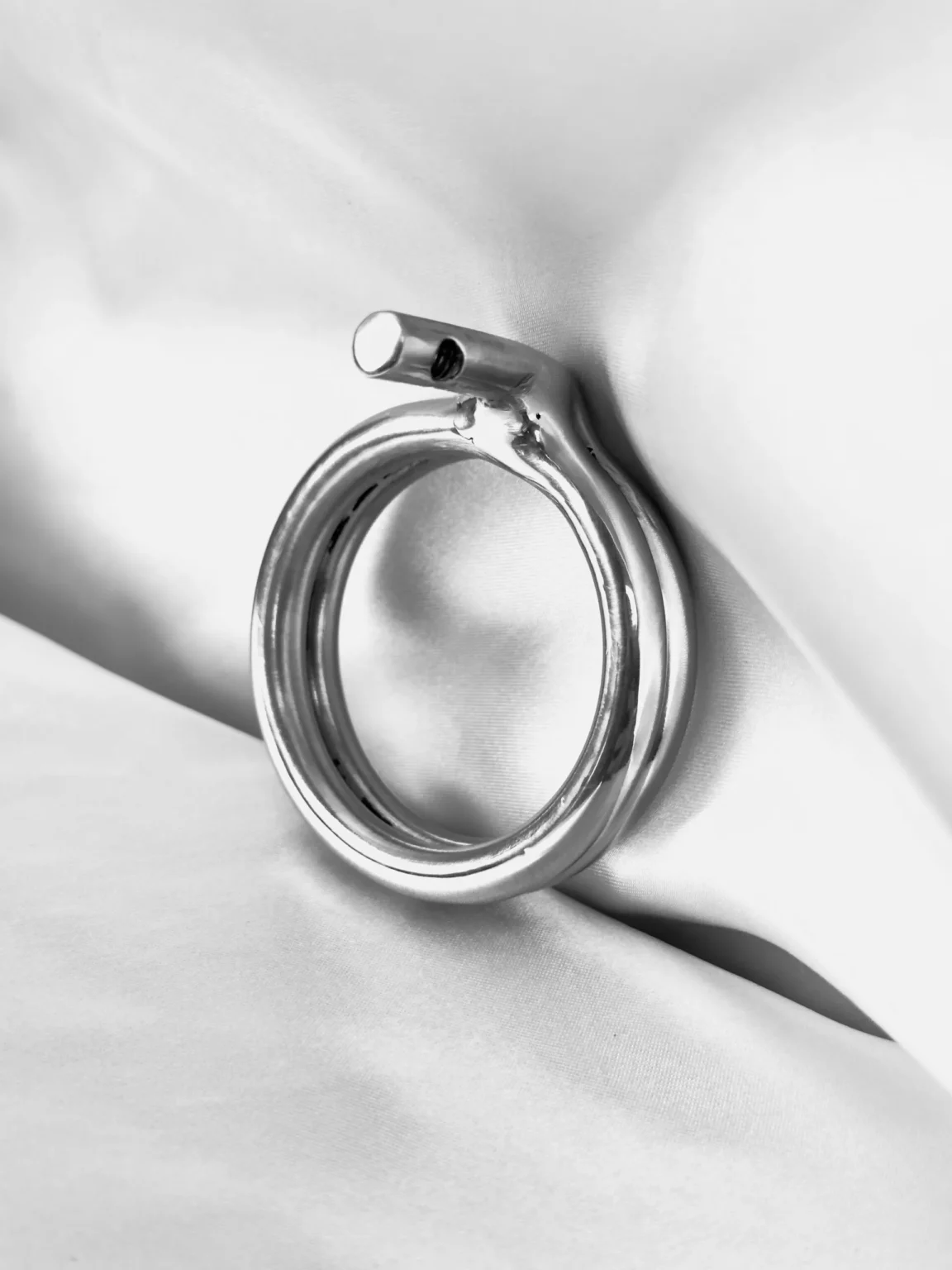
When testicles slip out of a chastity cage, it is caused by one of three issues.
First the gap between the cage and the ring. When the gap is too big it will allow the testicles to slip through.
The second is the lock. If the shank on a lock is too small it will allow the base ring to swing too far to the side and allowing the testicles to slip through. The problem is eliminated with a security screw. Sometimes over years of wear the Abus locks will wear down so much that they will allow the ring to swing. All that is needed is a new Abus lock.
The third is the Base ring. This is rare but if the base is many times bigger than needed then it can cause the testicles to pop through.
Keep in mind that cages are also called “Ball Trap Devices”.
A chastity cage has two main parts: a base ring that sits behind the testicles, and a cage that locks onto the ring in front. Between them is the gap. The testicles sit outside the device, in that gap, and they can’t pass between the cage and the ring. That’s what makes the device un-removable without the key. The gap’s function is to trap the testicles out.
So a testicle slipping out means one of three things has gone wrong with the trap: the ring is too big to hold, the gap is too wide for your anatomy, or the ring is moving in a way that opens up space it shouldn’t. Each has a different fix.
This is the one, nine times out of ten in the fitting emails we’ve answered since 2009.
The test. At your normal flaccid state see how many fingers you can get under the top of the ring up to the first knuckle without forcing. Exactly one finger, slightly snug, is the right size. Two fingers mean the ring is a size too big. None means too small. The purpose is tight enough to hold up the cage, loose enough to allow blood flow.
Why it slips. A ring that’s too large sits low and loose. The whole cage sags, the ring shifts as you walk or sit, and every shift is a moment where one side of the ring lifts away from the body far enough for a testicle to follow. It happens more in warm weather, more at night, more after a workout, all times the scrotum hangs lower.
The fix. One size down. If you’re pre-order, this is what the plastic sizing rings are for: start with the largest ring and work downward, one testicle through at a time then the penis, wait for your normal flaccid state, and run the finger test. Follow the instructions. If you already have a Mature Metal device, contact us: unlike other manufacturers, we can adjust the base ring diameter, no new ring purchase needed. If your cage is from another maker, you’ll likely need a new ring in the smaller size.
Even a ring that passes the finger test can let a testicle escape if it’s free to swing side to side. The lock does more than lock.
On our devices, the Abus lock is chosen partly for this reason: its shank is the right thickness for our devices, it sits sideways against the body rather than dangling, and it holds the ring in place to prevent the side-to-side swing that could let the testicles escape. The security screw goes in the same threaded hole and holds the ring the same way.
If you’re using a lock with a thin or long shank, or a padlock that hangs, the ring can rock. Every rock is a small opening. Switching to a lock that fits the hole properly, or to the security screw, often solves a slipping problem.
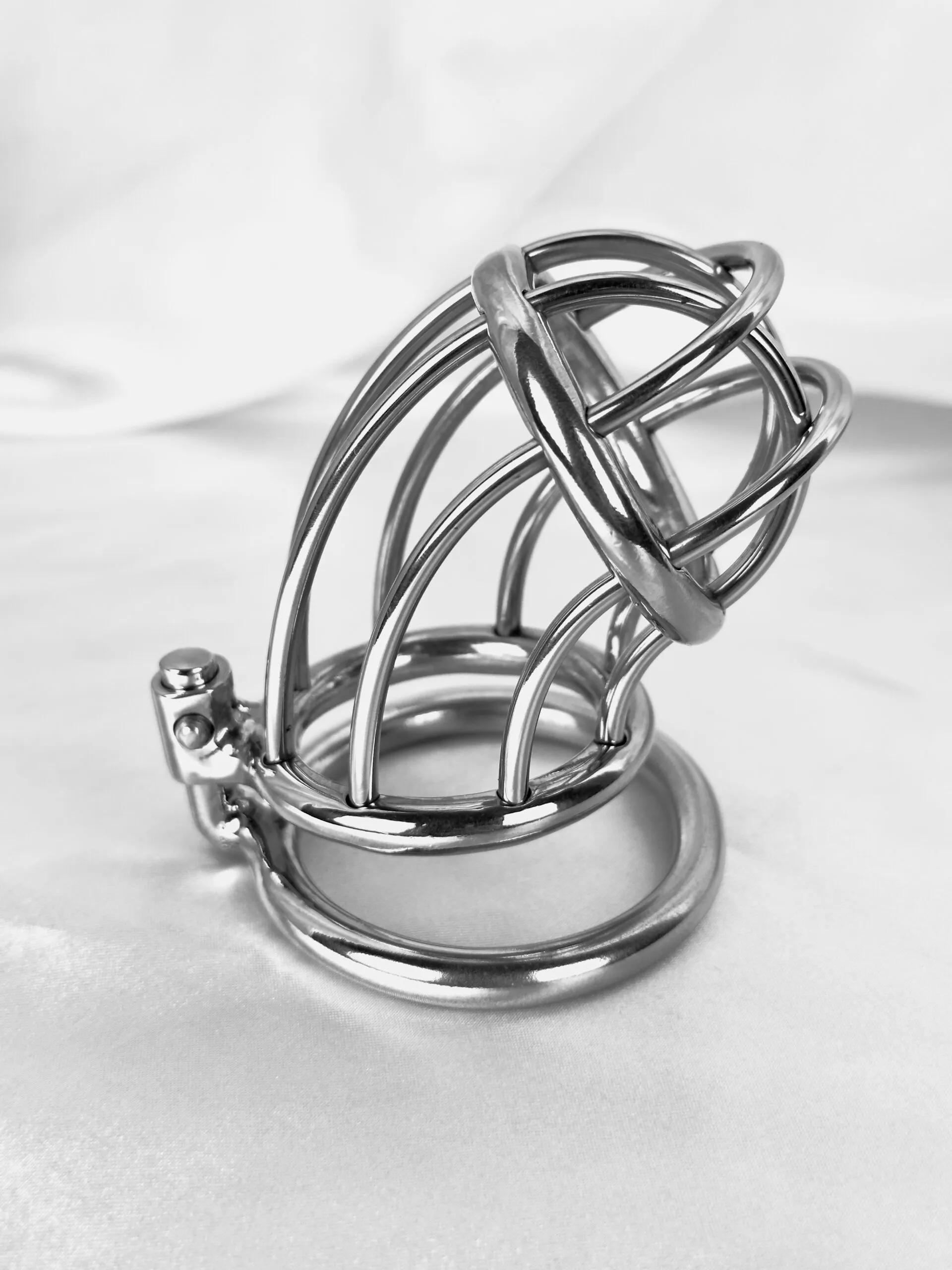
The gap is chosen, not measured, and our default of 3/8″ suits most clients. But a low-hanging scrotum can find room in 3/8″ that a high and tight one never would. William’s mapping is simple: low-hanging anatomy points to 1/4″; a high and tight scrotum, or a history of a burning sensation, points to 1/2″.
If the ring passes the finger test and the lock is holding it, and a testicle still finds its way between cage and ring, the gap is the next suspect. Because every cage is handmade, the gap can be adjusted to any size afterward. We’ll do it or talk you through doing it yourself. Or for a fee we will be happy to make the adjustment.
The scrotum isn’t a fixed shape. It’s higher and tighter when you’re cold and hangs lower when you’re warm, which is why the kit instructions say never measure right after a shower. Bodies also change over years: weight gain or loss changes ring fit, and long-term chastity wearers often find the scrotum hangs lower than it did at the start.
If a cage that fit for two years has started letting a testicle out, nothing went wrong with the cage. Redo the finger test at your normal flaccid state. If it’s two fingers now, it’s a ring or maybe a gap adjustment, which we do years after purchase.
One related case: the ring fits but the cage slides down and pulls, and you’re compensating with a tighter ring than is comfortable. Don’t. A well-fitted cage, one you fill at your normal flaccid state with no extra room, holds itself up without pulling. If it doesn’t, William’s suggestion is to consider a double base ring, which shares the hold across two rings rather than over-tightening one. Our seven fitting problems piece covers that scenario alongside the others.
If you’re pre-order, order the plastic sizing rings then follow the instructions. Use the finger test to find your ring; the sizing-ring results guide explains what you’re looking at, and the full sizing guide covers the other three sizes. If you already own one of ours and the ring’s letting go, email the workshop with the finger-test result and we’ll sort the adjustment.